
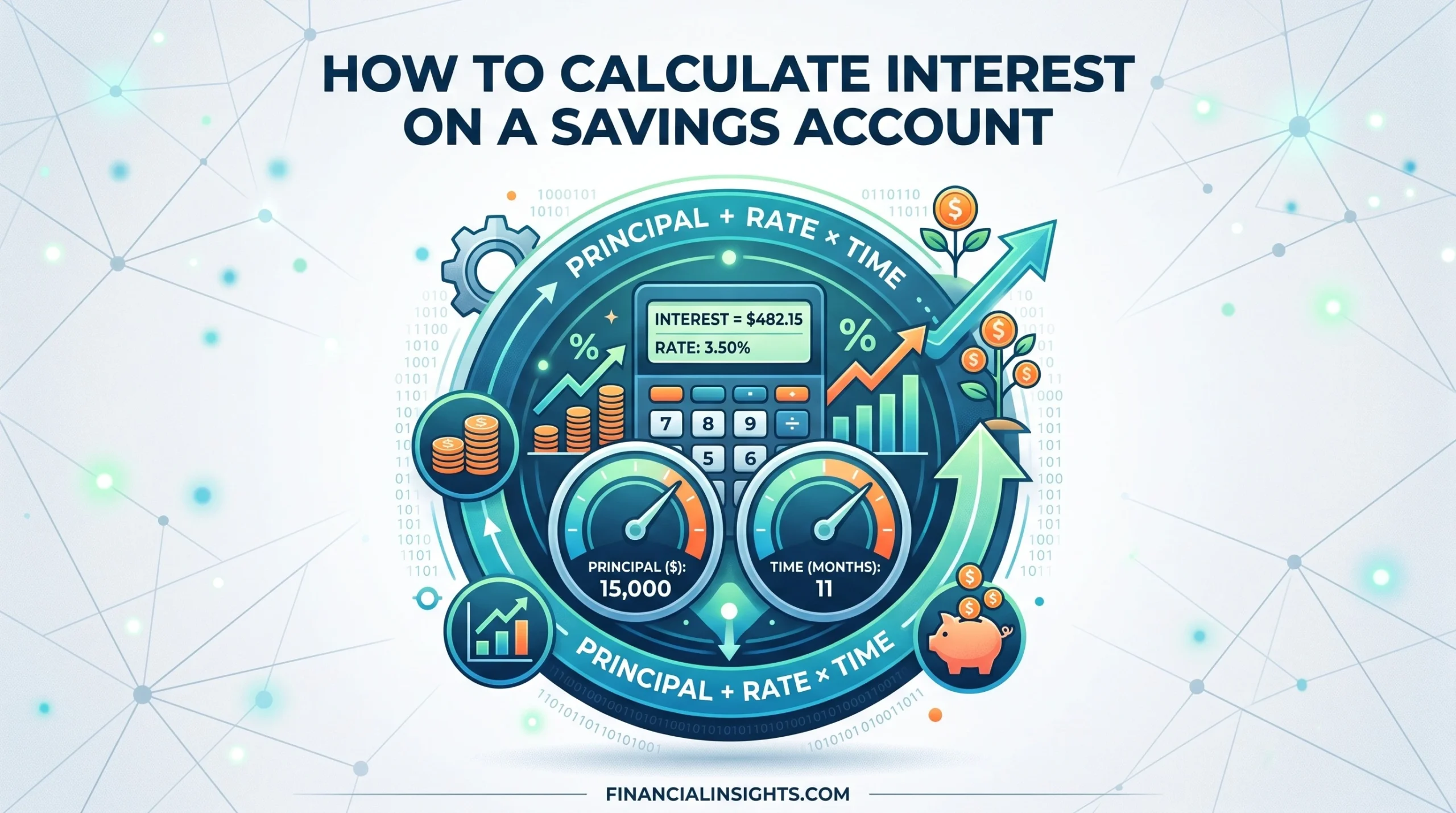
Putting money in a savings account is one of the simplest ways to make it grow. But how much will you actually earn? This beginner-friendly guide explains how savings interest works and which types of rates you will meet, so you can work out your earnings with confidence.
1. Understanding the Basics of Interest in Savings Accounts
What is savings account interest? Interest is money a bank pays you for keeping your savings with it. The bank lends your money to others, and you get a small reward for that.
Four simple terms help you calculate it:
- Principal: the money you deposit.
- Interest rate: the percentage the bank pays, usually per year.
- Time: how long your money stays in the account.
- Compounding frequency: how often interest is added to your balance (daily, monthly, quarterly or yearly).
Simple interest is the easiest method:
Interest = Principal × Rate × Time
Example: you deposit $1,000 at 4% for one year. That is 1,000 × 0.04 × 1 = $40.
Compound interest is what most savings accounts use. Your interest is added to your balance, and then that interest earns interest too. The formula is:
Final Amount = P × (1 + r ÷ n)^(n × t)
- P = your starting deposit
- r = annual rate as a decimal (4% = 0.04)
- n = times interest is added per year
- t = number of years
Example: $1,000 at 4%, compounded monthly for one year:
1,000 × (1 + 0.04 ÷ 12)^12 = $1,040.74.
That is $40.74 in interest, slightly more than the $40 from simple interest. The gap grows bigger the longer you save, which is why starting early matters.
Quick tip: the more often interest compounds, the more you earn. Daily compounding beats yearly compounding at the same rate.
2. Types of Savings Account Interest Rates
Not all rates work the same way. Here are the main types you will see:
Fixed rate: The rate stays the same for a set period, such as 12 months. It is predictable, so it is easy to plan around.
Variable rate: The bank can raise or lower the rate at any time, often following changes in the central bank’s rate. You may earn more or less than expected.
Tiered rate: Different parts of your balance earn different rates. For example, the first $5,000 may earn 3% and anything above that may earn 4%. Larger balances usually earn more.
Introductory or bonus rate: A higher rate offered for a limited time, such as the first 6 months. After that, it drops to a lower standard rate, so check how long the bonus lasts.
Nominal rate vs. APY/AER: This is one of the most important differences for beginners.
- The nominal rate is the headline rate before compounding is counted.
- APY (Annual Percentage Yield, used in the US and Canada) or AER (Annual Equivalent Rate, used in the UK) shows what you truly earn in a year, including compounding.
Example: a 4% nominal rate compounded monthly equals about a 4.07% APY. When comparing accounts, always compare APY or AER, not the nominal rate.
Final Thoughts
To calculate your savings interest, you need four things: your deposit, the rate, the time and how often interest compounds. Check whether your rate is fixed, variable, tiered or promotional, and compare accounts using APY or AER. A savings interest calculator makes all of this faster.
Savings Account Interest Calculator Free Fintech Tool
Simulate real compound growth, APY earnings, and regular deposit returns.
Savings Balance Growth Over Time
Annual Growth Breakdown
| Year | Total Deposits | Annual Interest | Total Interest Earned | Ending Balance |
|---|
Frequently Asked Questions
What is APY and how does it differ from interest rate?
The Annual Percentage Yield (APY) reflects the total amount of interest you actually earn on an investment over one year, accounting for the effect of compounding. The nominal interest rate (APR) is the flat rate without compounding. Because compounding earns interest on interest, APY is typically higher than nominal APR.
Simple Interest vs. Compound Interest: What’s the difference?
Simple interest is calculated exclusively on your original principal balance. Compound interest calculates earnings on both your principal and the accumulated interest from prior cycles. Over several years, compounding generates significantly faster wealth accumulation.
How often should interest compound?
The more frequently interest compounds, the faster your money grows. Most modern High-Yield Savings Accounts (HYSAs) compound interest daily and credit it to your balance monthly. While the mathematical difference between daily and monthly compounding is slight, daily compounding delivers maximum return.
How should you compare high-yield savings accounts?
When choosing a savings account, look beyond the headline APY. Verify deposit insurance (such as FDIC in the US or FSCS in the UK), watch out for minimum balance penalties, avoid monthly maintenance fees, and ensure withdrawal flexibility meets your emergency liquidity needs.