
Most people don’t lose money in savings accounts. They lose it to inflation — slowly, silently, over years of parking cash in a standard bank account earning 0.01% APY while prices rise at 3–4% annually. That gap is the real savings problem of 2026, and high-yield savings strategies exist precisely to close it.
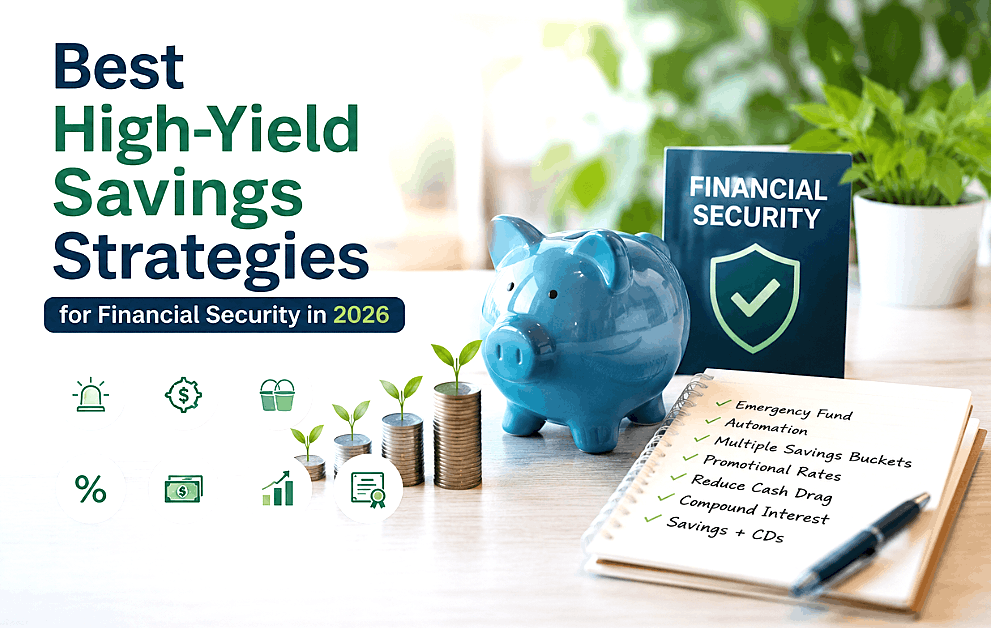
This guide explores the Best High-Yield Savings Strategies for 2026, helping you maximize returns, protect your money from inflation, and strengthen your overall financial position.
5.10%
Top HYSA APY (June 2026)
$1,200+
Extra interest on $25K vs. big bank
72%
Americans earning under 1% APY
Why High-Yield Savings Matter in 2026
When considering your financial security it starts off by having good accessible cash reserves. The investment strategy will aid you in building your wealth, however savings give you the security and protection you need when major events arise unexpectedly.
- An alternative (high-yield) savings strategy offers multiple advantages including:
- Higher interest rates compared to traditional savings accounts
- Better protection than an average savings account from inflation
- Easier accessibility to funds when needed
- Lower level of risk than compared to other investments like stocks and/or cryptocurrencies
- A desire to improve your savings discipline
As interest rates continue to fluctuate (increasing/declining) by the year 2026, those who implement optimal savings strategies may be able to earn hundreds or thousands of additional dollars of interest annually without any significant risk factors.
Online Banks vs. Traditional Banks: Where the Yield Gap Lives
Online banks — think SoFi, Ally , Marcus , and UFB Direct — operate with lower overhead than their branch-heavy counterparts. Those savings get passed directly to depositors in the form of higher APYs. Traditional banks, by contrast, have little incentive to compete on rates when their customers rarely shop around.
Credit unions round out the picture. They’re member-owned, typically non-profit, and frequently offer competitive yields with fewer fees. The catch? Membership eligibility requirements vary. If you qualify for a credit union with a strong savings rate, it’s worth a serious look.
⚡ Quick Strategy Check
If your savings account APY starts with ‘0.’, you are losing purchasing power every month. Open a comparison tool like Bankrate or NerdWallet and spend 20 minutes finding a better option. The signup process for most online HYSAs takes under 10 minutes.
Strategy #1: Emergency Fund: Build a Tiered Emergency Fund
Before optimizing yields, laddering CDs, or allocating to money market funds, one task takes precedence: building a liquid emergency fund. Three to six months of essential living expenses, held in an accessible HYSA. No exceptions.
Why? Because financial security isn’t just about growing wealth — it’s about not being forced to sell assets or take on high-interest debt when life interrupts. Medical bills. Job loss. Car repairs. These events don’t wait for your investment portfolio to be in a good position.
How Much Is Actually Enough?
The standard advice says three months for stable, dual-income households and six months for single-income earners, freelancers, or anyone in a volatile industry. But that’s a starting point, not a finish line.
A 2025 Federal Reserve survey found that 36% of Americans couldn’t cover a $400 emergency without borrowing. If you’re in that cohort, even a $1,000 to $2,000 starter emergency fund changes your financial resilience dramatically — start there and build incrementally.
Once the floor is in place, every additional dollar has options. That’s where the more sophisticated high-yield savings strategies start to earn their keep.

Strategy #2: Automation:Automate Savings Contributions
Every financial planner worth consulting will tell you the same thing: automate your savings before you automate anything else. The reason isn’t complicated — when transfers happen automatically on payday, the money is gone before you can spend it. This behavioral lock-in outperforms any rate optimization or fund selection by a wide margin for most people.
Even small amounts add up quickly over time.
For example:
| Monthly Savings | Annual Contribution |
| $100 | $1,200 |
| $250 | $3,000 |
| $500 | $6,000 |
| $1,000 | $12,000 |
Automation ensures consistency and prevents unnecessary spending before savings goals are funded.
Strategy #3: Use Multiple Savings Buckets
You can improve your financial organization by setting your savings aside into different categories, such as emergency fund, vacation, future home down payment, education, car replacement, and holiday spending. With each account having a specific purpose, you can assign at least one job to each dollar you earn and be able to track your progress toward that goal.
Having separate accounts off of your savings for these different categories not only helps you organize your finances but it also helps motivate you towards meeting that goal, as you can see the growth of your savings over time. Additionally, you’ll more likely continue to put money into the account(s) you’ve established and you are much less likely to spend on unrelated expenses from those specific accounts.
By clearly defining your accounts in this way, you’ll gain direction and develop more disciplined financial behavior.
Fortunately, managing multiple savings goals has become much easier in recent years. Many online banks and digital banking platforms now allow customers to create separate savings buckets or sub-accounts within a single account.
Strategy #4: Maximize Promotional Interest Rates Carefully
Promotional APYs are regularly presented by banks as a way of attracting new customers.
Such promotional APYs can be advantageous to gaining increased returns.
Make sure to gather information about:
- Minimum balances that must be kept
- How long the promotional rate is in effect for
- Any restrictions on withdrawals
- Any monthly account maintenance fees that will apply
Don’t be excessive in your pursuit of APY rates by adding layers of complication to your financial products. Instead, concentrate on banks that consistently offer competitive interest rates and strong business reputations.
Strategy #5: Reduce Cash Drag
Cash drag occurs when excess money sits in low-interest accounts.
Many individuals unknowingly keep large balances in checking accounts that earn little or no interest.
A smarter strategy involves:
- Keeping only monthly spending needs in checking.
- Moving surplus cash to high-yield savings.
- Reviewing balances monthly.
This simple adjustment can generate significantly more interest over time without increasing risk.
Strategy #6: Take Advantage of Compound Interest
Compound interest is often called one of the most powerful wealth-building tools available.
The principle is simple:
You earn interest not only on your original deposit but also on previously earned interest.
For example:
- Initial savings: $20,000
- APY: 5%
- Time: 10 years
Without additional contributions, the balance could grow substantially through compounding alone.
Strategy #7: Combine High-Yield Savings with Certificates of Deposit (CDs)
A balanced savings strategy often includes both flexibility and higher fixed returns.
Certificates of Deposit can complement high-yield savings accounts by offering:
- Predictable returns
- Fixed interest rates
- Low risk
- Guaranteed maturity dates
A popular approach is the CD ladder strategy.
Example CD Ladder
- 12-month CD
- 24-month CD
- 36-month CD
- 48-month CD
- 60-month CD
As each CD matures, funds can be reinvested at current rates. This strategy improves liquidity while maximizing returns.
Three Savings Mistakes That Quietly Derail Financial Security
Strategy gaps are often more damaging than bad luck. Here are the three most common errors worth explicitly avoiding:
1. Ignoring Rate Drift
Banks frequently offer promotional APYs to attract deposits, then quietly lower rates months later. Set a calendar reminder every 90 days to check your current yield against the top competitors. Switching accounts is free and takes an afternoon — rate loyalty to a bank that doesn’t reciprocate is expensive passivity.
2. Letting the Emergency Fund Inflate Endlessly
There’s a tendency to keep piling money into a ‘safe’ savings account well past the point of genuine security. Beyond 6–9 months of expenses in liquid savings, additional cash is likely better deployed in a CD, bond fund, or retirement account. Excess liquidity has an opportunity cost.
3. Overlooking FDIC Limits
FDIC insurance covers $250,000 per depositor, per institution. If your savings exceed that threshold, split balances across two or more insured institutions. It’s a niche problem — but one that’s genuinely worth knowing before it becomes relevant.
How Much Should You Save in 2026?
Savings goals vary depending on income, expenses, and financial objectives.
A useful guideline:
Minimum Goal
10% of income
Strong Goal
15–20% of income
Aggressive Goal
25% or more of income
If these percentages feel overwhelming, start small and gradually increase contributions.
Consistency matters more than perfection.
The Future of High-Yield Savings
Personal finance will continue to be improved by technology; by 2026, savers can look forward to:
- Ability of AI technology to create smarter budgeting tools.
- Ability of technology to automatically make your savings work harder for you
- Ability of mobile banking to enhance your experience while using your bank.
- Ability to transfer money more quickly from one account to another.
- Ability to access better financial education resources.
With the use of these innovations, people will have an easier time developing habits to save regularly and build solid long-term financial security.
Conclusion
Building financial security in 2026 requires more than simply setting money aside. A successful high-yield savings strategy in 2026 combines disciplined saving habits, smart account selection, goal-based planning, and ongoing financial review.
Whether you are a beginner in saving money or looking to improve an existing plan, making some small changes can yield big rewards in the long run. Contribution automation, high interest accounts, elimination of cash drag, and structuring your savings are some ways you could do so.
Start with one or two actionable strategies today, stay consistent, and allow time and compound growth to work in your favor. Your future self will thank you.