
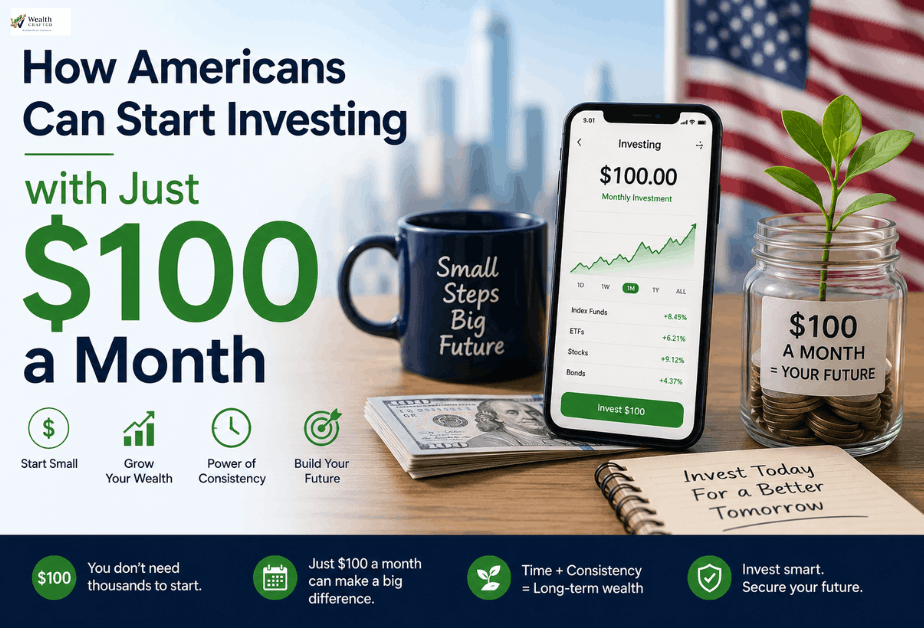
Quick answer: The easiest way start investing with just $100 a month is by opening a brokerage or retirement account, automating your deposits, and putting that money into low-cost index funds or ETFs. Thanks to fractional shares and zero-commission apps, $100 is more than enough to begin building real wealth today.
If you’ve been waiting until you “have more money” to invest, here’s the truth: waiting costs you more than starting small ever will. You don’t need thousands of dollars or a finance degree. You need $100, a little consistency, and a plan. Let’s break down exactly how to start investing on a modest budget.
Why $100 a Month Is Enough to Begin
A lot of Americans assume investing is only for the wealthy. It’s not. The rise of commission-free apps and fractional shares means you can buy a slice of a $300 stock for as little as $5. Investing just $100 a month removes the biggest excuse people have: “I can’t afford it.”
Here’s the magic behind small, consistent investing: compound growth. When your money earns returns, those returns start earning returns too. Over decades, that snowball effect turns modest monthly deposits into serious money.
Consider this. If you invest $100 a month and earn an average annual return of around 8% (roughly what the U.S. stock market has historically averaged over the long term), you could accumulate:
- ~$18,000 in 10 years (you contributed $12,000)
- ~$59,000 in 20 years (you contributed $24,000)
- ~$150,000 in 30 years (you contributed $36,000)
That’s the power of time in the market. The earlier you start investing, the less you actually have to contribute to reach your goals.
Step 1: Set a Clear Goal
Before you put a dollar anywhere, ask yourself why you’re investing. Retirement? A down payment? General wealth building? Your goal shapes where your money should go.
- Long-term goals (10+ years): Retirement accounts and stock index funds make the most sense.
- Medium-term goals (3–10 years): A mix of stocks and bonds keeps things balanced.
- Short-term goals (under 3 years): Keep that money in a high-yield savings account, not the market.
For most people starting to invest with $100 a month, the goal is long-term growth, which makes the next steps simple.
Step 2: Choose the Right Account
You can’t invest without an account to hold your money. Here are the main options for Americans:
Roth IRA – A retirement account funded with after-tax dollars. Your money grows tax-free, and qualified withdrawals in retirement are also tax-free. This is one of the best places to start investing for long-term growth.
Traditional IRA – Contributions may be tax-deductible now, but you’ll pay taxes when you withdraw in retirement.
401(k) – If your employer offers one, especially with a match, start here. An employer match is free money. Contributing enough to get the full match should always come before anything else.
Taxable brokerage account – No contribution limits and no withdrawal restrictions. Great for goals that aren’t strictly retirement.
If you’re unsure, a Roth IRA is a fantastic default for younger investors and anyone expecting to be in a higher tax bracket later.
Step 3: Pick a Broker or App
Opening an account takes about 10 minutes. Popular, beginner-friendly platforms in the U.S. include Fidelity, Charles Schwab, Vanguard, Robinhood, and SoFi. Look for these features:
- No account minimums
- Commission-free trades
- Fractional shares (so your full $100 gets invested)
- Low expense ratios on funds
Fidelity and Schwab are especially popular because they combine strong reputations with zero-minimum accounts and excellent low-cost funds.
Step 4: Decide What to Buy
This is where most beginners freeze. Don’t overthink it. When you’re investing just $100 a month, simplicity wins.
Index funds and ETFs are your best friend. Instead of betting on a single company, you buy a tiny piece of hundreds or thousands of companies at once. This spreads out your risk automatically.
Great starter options include:
- S&P 500 index funds (like VOO, SPY, or FXAIX) which track the 500 largest U.S. companies
- Total stock market funds (like VTI or FZROX) which cover nearly the entire U.S. market
- Target-date funds which automatically adjust your mix as you approach retirement
A single S&P 500 index fund is a perfectly respectable place for your entire $100 when you’re just getting going. Boring is beautiful in investing.
Step 5: Automate Everything
The number one predictor of investing success isn’t picking the perfect stock. It’s consistency. Set up an automatic transfer of $100 from your checking account every month and automatically invest it. This is called dollar-cost averaging, and it means you buy more shares when prices are low and fewer when they’re high, smoothing out the ups and downs.
Automation also removes emotion from the equation. You won’t panic-sell during a dip or forget to invest during a busy month. Set it and forget it.
Step 6: Leave It Alone and Stay Consistent
Once your money is invested, resist the urge to check it daily or react to headlines. The market will rise and fall. That’s normal. The investors who win are the ones who keep contributing through good times and bad.
As your income grows, try bumping your contribution to $150, then $200. But even if you never increase it, sticking with $100 a month for decades can still build a six-figure portfolio.
Common Mistakes to Avoid
- Waiting for the “perfect” time. There isn’t one. Time in the market beats timing the market.
- Chasing hot stocks or crypto hype. Stick to diversified funds while you’re learning.
- Cashing out during a downturn. That turns temporary dips into permanent losses.
- Ignoring fees. High expense ratios quietly eat your returns over time.
Frequently Asked Questions
Is $100 a month really enough to start investing?
Yes. With fractional shares and commission-free apps, $100 a month is plenty to start investing and build meaningful wealth over time through compound growth.
Where should a beginner invest $100 a month?
A low-cost S&P 500 index fund or total stock market ETF inside a Roth IRA is one of the simplest, smartest choices for beginners.
How much will $100 a month grow over time?
At an average 8% annual return, $100 a month could grow to roughly $150,000 over 30 years, far more than the $36,000 you’d contribute.
Do I need to know a lot about the stock market to start?
No. Index funds let you invest in the whole market without picking individual stocks, making them ideal for beginners.
The Bottom Line
You don’t need to be rich to invest. You need to start. By opening the right account, choosing a simple index fund, and automating $100 a month, you’re setting your future self-up for real financial freedom.
The best time to start investing was years ago. The second best time is today.